A chew toy can make sense on a shop shelf and turn out to be awkward five minutes after you bring it home. Your puppy might be able to push the entire narrow end into their mouth, or keep working one seam while the rest of the toy stays untouched. Another puppy may nose the same object across the floor and give up because they can't hold it still. A useful choice begins with the way your puppy actually uses an object. The first session is an opportunity to look, make one change if needed and put the toy away before the room gets busy.
Puppies naturally explore with their mouths. Give them appropriate opportunities to chew while you supervise, and ask your veterinarian for help choosing a suitable chew if you are unsure. A toy's description can narrow the choice, but it cannot tell you what your individual puppy will do to it. Plan the session at a time when you can see the whole toy and the puppy's mouth. A few quiet minutes beside an open stretch of floor are more useful than leaving a new chew out during dinner and trying to guess afterward what happened to it.
Start with an object you can inspect
Read the product directions for the intended size, age and use. Look at the toy's overall size as well as the part the puppy is most likely to grip. Avoid an object small enough to swallow, and check that protruding parts cannot be torn away easily. Choose one with a shape the puppy can steady without having to wedge it against furniture. Extremely hard materials can damage teeth. VCA Animal Hospitals advises avoiding very hard chews such as bones and antlers and choosing a puppy toy with some give. Your veterinarian can help if a puppy has specific dental concerns or is unusually determined to break pieces off.
Inspect a new toy in good light. A sharp edge, a loose insert or an unraveling stitch is a reason to set it aside. Check what the toy is supposed to look like when it is intact. If there are several parts, understand which ones are meant to come apart and whether the directions require special handling. Pick a design you can check in a few seconds. A complicated object that is difficult to take apart for cleaning or inspect after a session may be less practical than one with fewer surfaces.
Size and strength can change quickly as a puppy grows. A toy that was difficult to carry a few weeks ago might now fit far enough into the mouth to cause concern. Check the directions again when the puppy's use changes. If an object that used to show a few tooth marks suddenly has a deep split, retire it. Choosing a toy that fits this week is more useful than assuming it will suit the dog for the rest of the year. Keep the packaging or take a picture of the directions so you can find the relevant limits later.
Set up a short session you can stop easily
Clear a little floor space and put shoes, cords and bags out of reach. Use a spot where the puppy has room to lie down, turn and step away. Watch from close enough to notice a piece loosening. If a favorite piece of furniture leaves an opening where the toy can disappear, move the session somewhere else. Having to reach under a cabinet while the puppy is trying to retrieve the same object can turn a simple game into a scramble. Start on a surface where you can see everything that happens.
Offer the toy while the puppy is awake and has a moment to explore it. Set it on the floor and leave enough space to approach from the side. If the puppy picks it up and puts it down, you can wait and see whether they return. A toy doesn't need to hold their attention for the whole session. If they try to carry it into a place you cannot see, move the next session to a better room or choose an appropriate toy that is easier to manage in the open. Keep the exit available so the puppy can leave.
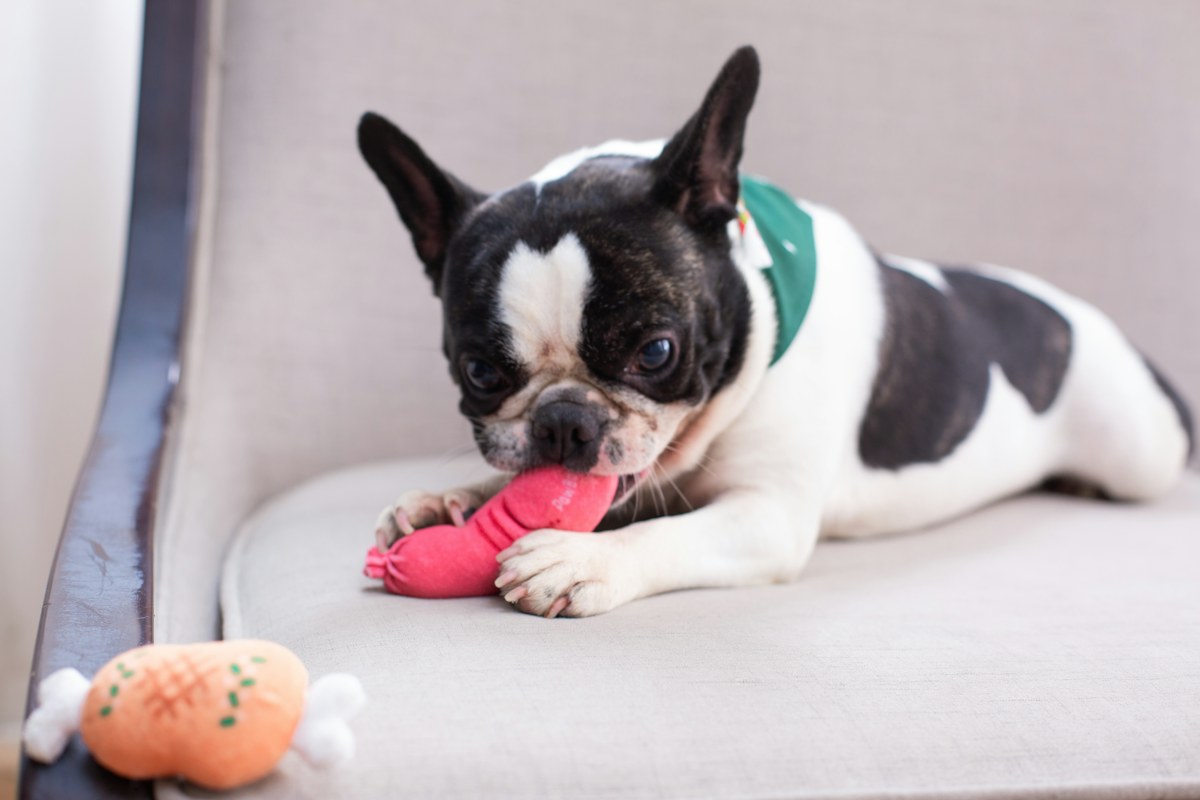
Stay present as the chewing starts. Look for how the toy sits in the mouth and where the puppy applies force. A puppy who makes many short nibbles may affect the toy differently from one who grips the same edge and pulls. If you notice a loose piece, split or other damage, stop the session and remove the toy when you can do so safely. Do not reach into a puppy's mouth to argue over an object. If the puppy guards it or becomes distressed when somebody approaches, give them space and ask a qualified behavior professional for guidance.
Use the session to learn what suits the puppy
Watch whether the puppy can settle with the toy or keeps having to chase it. A rolling shape might be useful in a brief shared game but awkward for chewing. A toy that needs to be braced against a wall may spend most of its time disappearing behind the furniture. Try a flatter shape next time if the puppy repeatedly loses control of the object. The floor can change the experience too. A toy that sits still on a rug may slide away across tile. Pick the simplest combination that gives the puppy a comfortable way to hold it.
If your puppy focuses on a household object instead, remove access to it calmly where you can and offer an appropriate chew. Reward voluntary interest in the toy. Make a note of what attracted the puppy to the other object. A shoe might have been on the floor in the middle of an active room, while the toy was somewhere the puppy could not reach. A chair leg might have been the easiest thing to grip. Changing the placement of both objects can be more effective than trying to interrupt the same behavior every day.
Choose times when you can supervise consistently. For example, set out a chew while you sit nearby during a short break, and put it away before you go to another room. Avoid planning to watch from across the house. Other people can share the routine if they know which toy to offer and what damage looks like. You can set the approved toy in one place and leave the rest secured away. Keeping the choice small is especially helpful when a guest is spending time with the puppy for the first time.
Keep puppy chew sessions separate when an adult dog shares the room. The adult may approach the moment they hear the puppy working on something. A space with a closed door or a suitable barrier can let both dogs keep their distance. Take care that neither dog can move the barrier and that the puppy is still within view. If one dog spends the session pacing near the other, change where the session happens. Quietly chewing an item calls for a different arrangement than playing together.
Give the puppy a way to rest afterward. If you notice they go straight from the toy to circling around the furniture, look at whether the room is busy or their usual sleeping area is blocked. Put the toy away and open the route to a familiar place. A short chew does not have to lead into another game or a trip around the house.
Check the toy when the puppy has moved on
Once the puppy releases the toy and leaves it, pick it up and look over the surface. Rinse or wash it as directed, dry it before storage if the instructions call for it, and check the spots that were held most often. Small tooth marks can be easier to see on a clean surface. Compare what you find with the original condition. A toy that is becoming ragged may need to be replaced before you can see a missing piece. Store it where the puppy cannot return to it between supervised sessions.
If an item is damaged, remove it from the collection immediately. Leaving it in the basket while you look for a replacement can lead to somebody else handing it back. If you think the puppy has swallowed a piece, contact your veterinarian promptly for advice. Keep the toy and any packaging available so you can describe its material and size. Choking or difficulty breathing requires emergency care. A photo of the damaged item can help show which part is missing. The point of the check is to catch a change early, while you still know exactly what happened during the session.
When a toy works well, remember what made it easy to use. It may have been the size, the shape or the space where you offered it. Take that information with you the next time you choose a replacement. A useful selection can be very small: an appropriate chew you can check, something for a supervised game, and a clear place where both can be put away. The puppy will change, and the way you use the room may change with them. A routine built around watching and inspecting the toy can adjust without filling the house with new objects.