Look at the floor before bringing out the toy
A living room can seem spacious until two dogs turn toward the same ball. The open area may be the space between a sofa and a glass table, or the short stretch between a rug and a cabinet. The dogs have little room to change direction, and one may run into the other's side when it tries to stop. For indoor play, start by looking at the corners where the dogs would be likely to turn. Choose a broad area with a steady surface, or keep the activity slow enough that the dogs do not need to run.
Clear anything that can be bumped, dragged or caught. Take bags off the floor, close drawers and move cups from low tables. Leave an open route out of the play area on at least one side, preferably with space for each dog to go its own way. If there is only a narrow gap between pieces of furniture, separate the dogs for individual play or take a suitable game outside. Clearing one obstruction is sometimes enough to make space for gentle play. Moving the sofa across the room every time usually means the plan is too cumbersome to repeat.
Check where the rug ends. A dog can get good traction at the start of a short movement and then slide when its feet meet smooth flooring. Turn a loose rug or replace it with a stable surface if it moves easily. Keep the dogs away from rugs with curled corners during play. Try a few steps yourself with shoes off or in the footwear you normally use indoors. If you hesitate when turning, choose a different game or another part of the room.
Choose a game each dog can leave
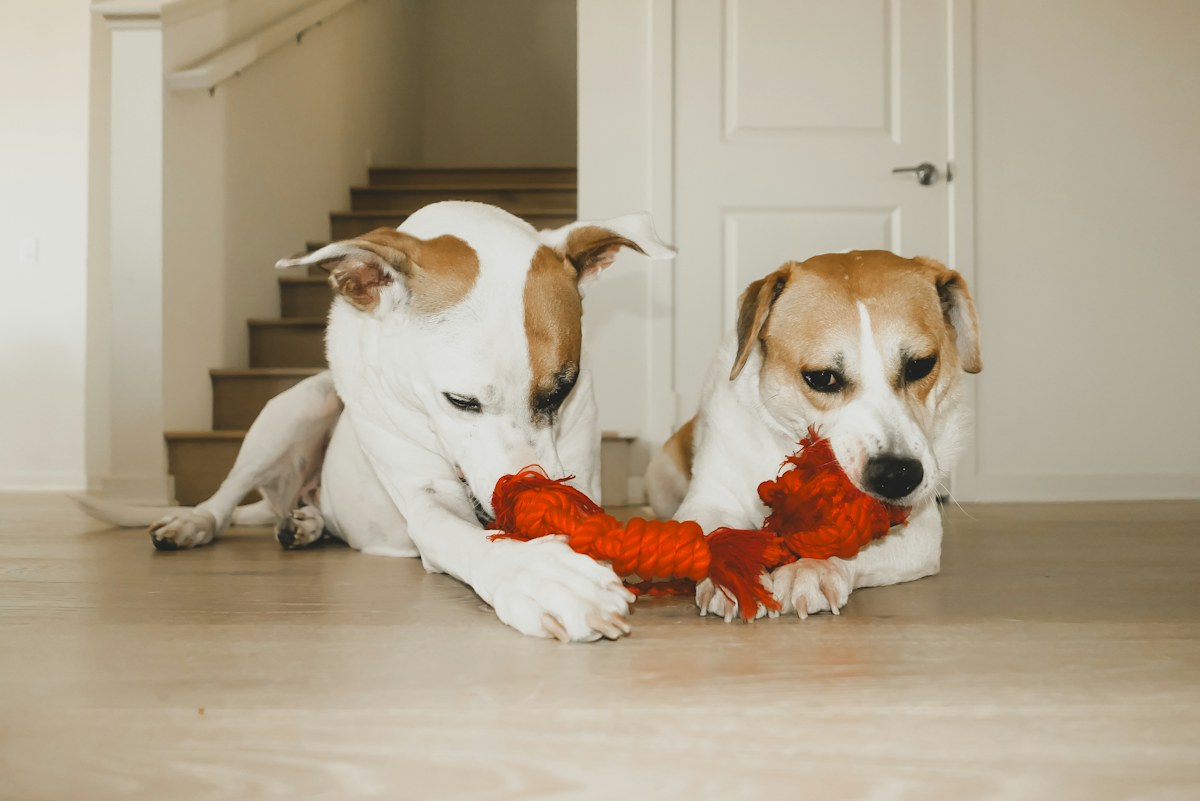
Play can work with one dog using a toy while the other takes a break. It can also work with two separate toys if each dog can keep to its own area. A ball rolled across both dogs' paths encourages them to run to the same point. For a quieter game, you can place or roll an individual toy a short distance away from the other dog. If both would choose the same toy regardless of where it lands, put away the extras and use separate areas. Adding more objects does little when one of them is clearly the one both dogs want.
Select toys appropriate to each dog's size and the way it handles them. Check toys for loose pieces, splitting seams or parts that may come off. A toy can be safe for supervised play with one dog and a poor match for two dogs pulling in different directions. Choose one you can put away when the game ends. Do not try to take a toy out of a dog's mouth if you are concerned about guarding or tension. Make a separation plan first and seek professional guidance if ordinary toy handling is already difficult.
Watch for whether the dogs choose to return after they move apart. One may bring the toy to the edge of the room and drop it. The other may stop near its handler. A dog that takes a short break and comes back on its own is doing something different from one that tries to move away while the other keeps following. End shared play or set up separate areas when one dog cannot leave freely. The extra space is there to be used, including by a dog that would rather rest.
Give a second person an easy role
When two people are available, have each stay near one dog. Stand far enough apart that the dogs can move toward their own person without crossing. In a large room, one person might use the end near the sofa while the other works closer to the hall. Start with a simple movement, such as asking each dog to follow its own toy for a few steps. Finish before moving both toys around at once. That makes it easier to see what happens if one dog loses interest or turns toward the other.
Agree on a phrase to pause the activity. When someone says it, both people stop moving the toys and give their dogs space. For dogs that already respond comfortably to a cue to come away, use the familiar cue, then let them rest on their own sides. If a dog stays focused on the other toy, add distance or end the session. A cue is useful when the dog can follow it. Good room layout and planned separation remain necessary if a cue cannot interrupt the activity reliably.
When one person is alone, think about whether you can supervise both dogs while putting a toy away. A room divider or secure gate can make individual play straightforward, as long as dogs remain comfortable with the separation. Put one dog in a familiar area, play briefly with the other, then exchange places with toys out of the walking path. If the dog behind the gate is distressed or keeps watching the other dog closely, a closed room or play at different times may make for a calmer routine.
Choose a break point while things are going well
Start with a short period of play, then stop and observe. Some dogs shake, walk away, look around or return at a slower speed. Others stay focused on the other dog's movements or begin taking up more space. Use the pause to see whether both dogs are able to turn their attention elsewhere. If one dog remains fixed on the other or repeatedly moves into its path, change the setup before resuming. A pause is useful even when the game looks friendly at first glance.
You do not need to fill every break with food. In a household where food creates crowding, offer it only with secure separation or use a simple end to the activity. Put toys away when it is safe to do so, then give each dog room to choose a resting spot. If one dog guards items or a resting place, manage those areas separately and ask a qualified professional for help when needed. Avoid reaching between dogs or moving into a confrontation to recover a toy.
Sometimes the reason to end is the room itself. A delivery arrives, a child begins playing on the floor or someone needs to cross with a hot dish. Switch to a familiar separation plan while the route is still clear. If the dogs repeatedly lose their footing or bump furniture in the same place, revise the activity rather than working around a predictable collision. A short game can be satisfying without using every part of the room.
Adapt the game to different dogs
Two dogs can enjoy different levels of movement. A younger dog may follow a toy repeatedly while an older dog is interested in one short turn and then settles. Let the older dog choose a place where it can watch without being approached every time the toy moves. Keep the more active game on the far side of the room, or move it to a different room. If the younger dog regularly carries toys toward the resting dog, use individual sessions and pick up the toys before letting them share the room again.
A confident dog may claim the center of the floor while a quieter one moves along the edge. Give the quieter dog a way to approach without crossing the center. You can start each dog in a separate section, leave more distance, and choose a toy that stays near the person using it. If one dog waits for the other to stop before taking any turns, that is useful information about how the setup feels. Play separately until both can choose whether to engage.
Some indoor spaces only support slow activities. A dog can find a familiar toy placed in an open spot while another waits in a separate area. It can follow a soft toy across a short distance without chasing it at speed. Choose simple activities that fit the floor, the dogs and the supervision available. If you want to practice energetic games, choose a safe location that actually has room for them, and give both dogs the same freedom to stop.
Put the room back in order
At the end of play, clear the toys from places people step. Look beneath a chair or along the base of the sofa, where a toy can become wedged. Leaving one dog to retrieve it while the other stands at the entrance puts both back in a confined space after the game has ended. Pick up stray objects after the dogs have left the area, and check any toys that took extra wear. A loose seam you find now is one less thing to check in the middle of the next session.
Before you plan another game, remember the moment each dog took a break. Was it able to leave? Did the other dog continue playing or follow it? Was the person nearby able to step out of the way? These details reveal whether the room worked better than a tally of how long the dogs played. Keep the version that gave both dogs room to choose their next move. If the easiest version uses two short turns instead of one shared chase, use the setup that actually fits the home.