Meet where people can keep walking
The narrow entrance to a park is a poor place to find out how closely two dogs can walk. People tend to stop just past the gate and work out where to go. Dogs reach the ends of their leads, and anyone coming through the opening has to pass within a step or two. Choose a meeting place with room to move sideways and enough space for one person to continue walking while another is still getting ready. A broad, quiet stretch of path just outside the park can be easier to use than a landmark everyone knows.
Tell the group where to start and which direction to go. If you can, pick a landmark past the start and let everyone approach it at their own pace. There is no need to gather around one person for instructions if the route is already agreed. The important information is where the path narrows, which side the group will use, and where someone can leave early. When a dog needs space from the others, its handler should be able to take it around a corner or down a side path without asking the whole group to move first.
For a new pair, one dog can start walking before the other sets off. Follow in the same direction from a distance at which both can look around, pause and move on. A group in motion has more options than one standing at a gate. If the dog at the back closes the gap whenever the leader slows, begin farther apart. Do not use the first few minutes to see how close they can get. Use them to find the spacing that makes it easy to continue.
Choose a route that gives you exits
Walk the route alone if you do not know it. Check whether a wide section continues or stops at a footbridge, a gate or a stretch with a hedge on one side and parked cars on the other. Note the places where people commonly turn up from a direction you cannot see. A path can look empty from one end and still be busy where it crosses an entrance to a playground. Select a quiet time if the useful spaces disappear during school pickup or a regular market.
A loop with two or three ways back is forgiving. A handler can turn off when their dog has had enough, and another can take a shorter version without feeling left behind. An out-and-back route has a clear endpoint, but the group will eventually need to turn. Pick an open area for that, where each handler can turn with their dog at their own pace. On a narrow route, the first people to turn would otherwise have to pass every dog behind them.
Choose a route suited to the person and dog who need the easiest footing or shortest outing. A steep bank beside the path is not a useful place to wait if someone has trouble walking on it. A grassy verge can work when it is dry and open, but a muddy strip beside traffic is a poor substitute for a wider path. Agree ahead of time on the stretch you can skip if it is busy. An alternative made while looking at a map is easier to use than one made while several people are waiting at a junction.
Arrange the group so each handler can see
Give each dog its own handler when you can, especially on a first shared walk. A person controlling several dogs has less room to move a lead or step sideways when the group changes pace. Use secure, familiar equipment and enough lead control to keep the walking path clear. Avoid letting a long line span the path or cross another handler's feet. Where local rules require leads, keep dogs on them throughout the route.
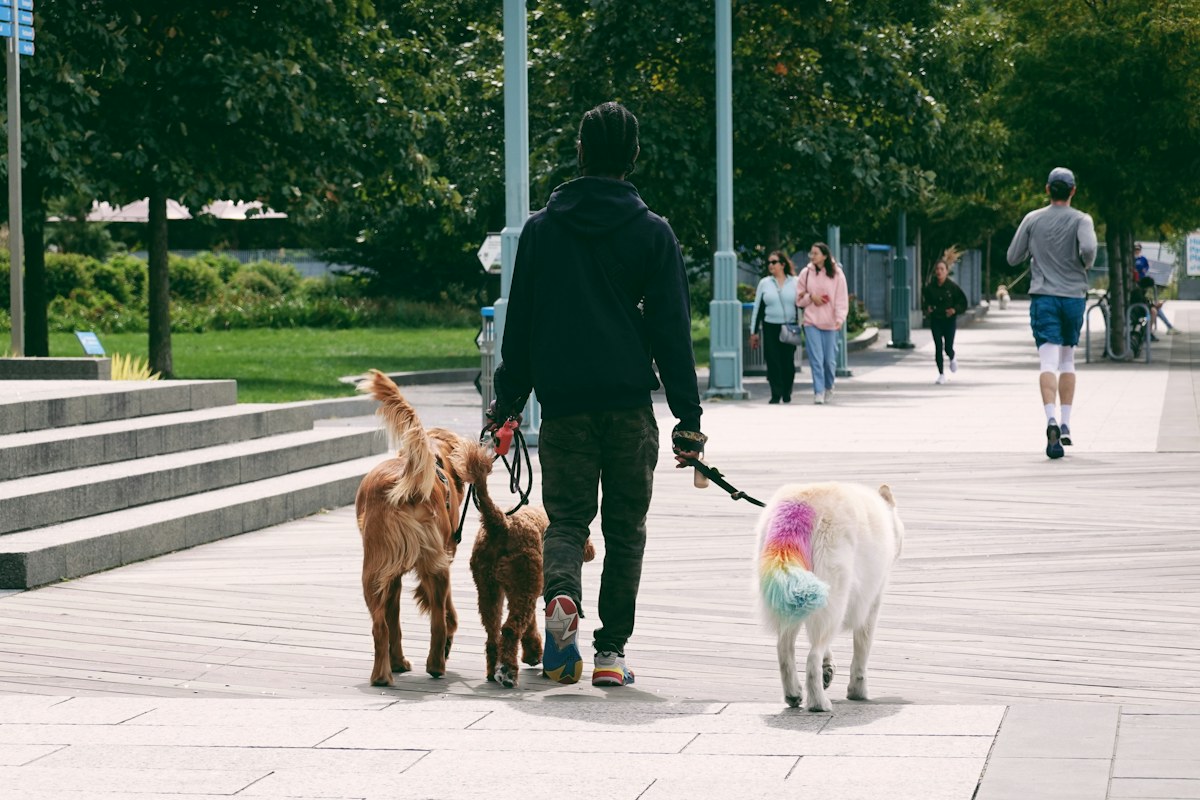
Start with more distance than you think you will need. Let the dog at the front walk far enough ahead that the dog behind can stop to investigate without the next handler having to stop abruptly. In a wide open area, a pair may walk roughly alongside one another with a broad gap. If the dogs start tracking one another's every step or the gap keeps narrowing, return to a staggered line. The comfortable spacing can be different for each dog. Use what you see on that walk.
Keep the leading dog out of blind corners until you know the group has room behind it. A handler at the front can signal a narrowing in a normal speaking voice, then slow somewhere the others can see. Agree on one short phrase such as 'single file' or 'let's give space'. A long conversation about who should move can wait for a clearer part of the route. Dogs often change speed when people pause to talk, so keep a small buffer even when everyone thinks they have stopped.
Pass people, gates and dogs in stages
When someone approaches, one option is to step well aside where there is a firm, wide shoulder and let the passerby continue. Pick the space early, before everybody has reached the same small patch. Move the dogs far enough apart along the shoulder that each can turn without swinging into the next one's lead. Keep the footpath clear. Some dogs do better if they can continue moving, in which case a wide arc or a quiet turn away may be easier than standing still while someone passes.
A gate is best handled by one person at a time. One handler opens it and moves their dog well beyond the gate before the next starts. The person waiting stays back from the opening so a dog on the other side has room to turn. If the gate springs closed or the ground slopes, slow down and let someone without a dog hold it if that is easy to arrange. The group can come together again beyond the bottleneck if there is room. There is no reason to close every gap as soon as the path widens.
An unfamiliar dog coming toward you changes the plan. Consider whether the other handler can actually see the whole group and whether both sides have space to pass. Cross to a wider section when it is safe, or turn the group away before the leads get tight. Give the other person time to move through. A greeting can be skipped without anyone having to explain. If two familiar dogs are going to greet, use a roomy location, check with both handlers and keep the other dogs out of the immediate approach.
Make stops short and easy to leave
A dog that normally pauses often can feel hurried in a moving line. Build in a stop at a spacious place rather than expecting every dog to match the speed of the front handler. Let people spread along the edge of the path, then leave a gap before restarting. Individual sniffing pauses can also work when the person behind knows to wait back or pass with room. The group can regroup a little farther on. A walk does not need to stay in a tight formation to count as shared.
If you bring water or rewards, use them with space around each dog. Set one bowl out at a time away from the others, or take turns at separate points. Put food away before dogs move close together. A handler who stops to look through a bag should be able to keep their own dog in view. Do the same for waste bags, where the person is likely to need both hands for a moment. Choose a place off the flow of the path whenever you can.
Agree on a way for people to leave the group midway. A dog may start pulling continuously, hanging back or repeatedly checking behind itself. Those changes are a reason to increase distance, shorten the walk or finish separately. A group outing can be a difficult setting for a dog that is already uncomfortable around others. Arrange a separate walk and seek advice from a qualified professional when you need help making a safe plan.
Use the first walk to improve the next route
After the walk, ask each handler where their dog moved most comfortably. You might learn that the rough gravel after the bridge was harder than the narrow bridge itself, or that waiting by the water fountain created the only crowded moment. Change one part of the plan next time. Start farther from the gate, add a wide stopping point, or split the group into two pairs for the stretch where people have to pass.
Keep the next outing similar if it went smoothly. A second walk on the same route lets you see whether the quiet spaces were reliable or simply empty that day. Watch for changes in who is attending, which entrances are open and how much time the group has. Space on a walk is something people maintain by choosing where to go, when to stop and how to let others pass. Good routes make those choices easy even when one dog needs to take the afternoon more slowly.
Leave separately at the end if the start point has become busy. A loose line of handlers can spread out while people pick up keys, open car doors or put bags away. Keep a dog clear of the road while another person loads a car. If everyone wants to talk after the walk, arrange to do it after the dogs have reached their own safe places. There is little value in adding a crowded finish to an otherwise quiet route.